Table of contents
- The Caduceus of Mercury: An Ancient Symbol of Sexual Alchemy
- The Serpentine Fire: From Sexual Essence to Spiritual Illumination
- The Serpent and the Ascent of the Creative Force
- The Serpent as the Dual Symbol of Fertility and Illumination
- The Serpentine Fire and the Illumination of the Inner Eye
- Ojas: The Sexual Force as Fuel for Illumination
- Brain and Semen: The Connection to Intelligence and Mental Vitality
- Where Ancient Wisdom and Physiology Meet
- Who Was Dr. Raymond W. Bernard?
- Science Discovers the Physiological Value of Continence by Dr. Raymond W. Bernard
- The Physiological Value of Semen and Its Conservation
- Neuroses and Psychoses
- Neuroses and Psychoses — Continued
- Brain and Semen
- Brain and Semen — Continued
- Brain and Semen — Continued
- Chemistry of the Semen
- Chemistry of the Semen — Continued
- Chemistry of the Brain
- Chemistry of the Brain — Continued
- Nerves
- Nerves — Continued
- Nerves — Continued
- Nerves — Continued
- Thymus
- Thymus — Continued
- Bringing It All Together
- The Caduceus: A Symbolic Map of the Creative Force
- Sexual Alchemy: From Generation to Regeneration
- Raising the Creative Force: From the Sexual Center to the Brain
- The White Dragon, the Shadow Dragon and the Light Within
- The White Dragon, the Shadow Dragon and the Light Within — Continued
- From the Serpent of Regeneration to the Physiology of Bernard
- From the Serpent of Regeneration to the Physiology of Bernard — Continued
- From Generation to Regeneration: The Central Principle
“In general terms, the sexual organs of the male may be called the nether brain. In the nerves that emanate from them and enter into the structure of the testes, there is a larger percentage of the same sort of matter that is found in the brain than we find anywhere else in the body outside of the brain proper.”
– S.R. Armstrong, Sexual Vitality: A Key to Health and Vigor
The Caduceus of Mercury: An Ancient Symbol of Sexual Alchemy
A Sacred Symbol Misunderstood and Obscured
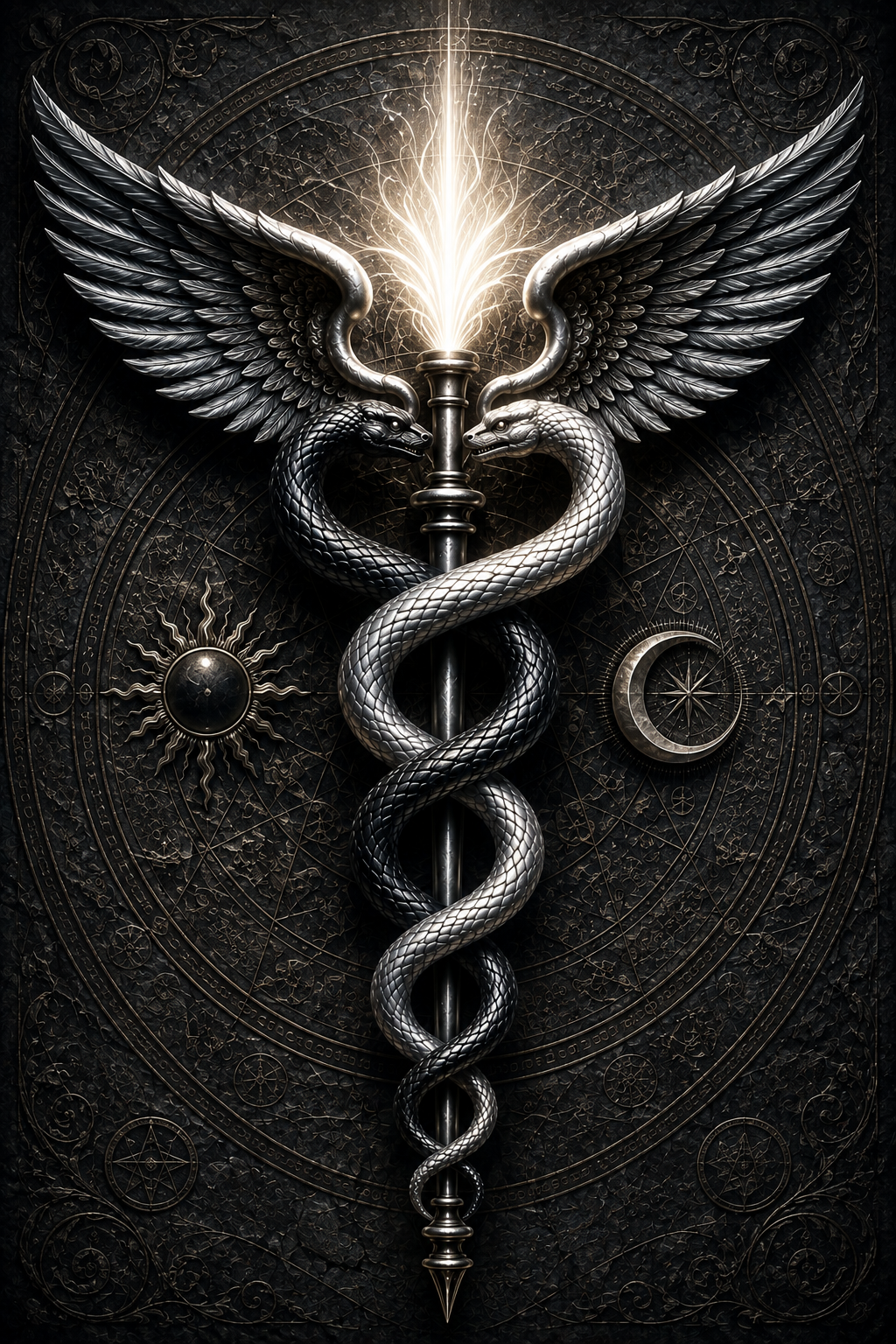
Before diving into this article on semen and the brain, I would first like to discuss its chosen image. Perhaps no other ancient symbol better embodies this subject than the Caduceus of Mercury. The Caduceus is not what most people have been led to believe it is.
Like the occult itself, many people badly misunderstand the Caduceus and automatically equate it with evil. Dark forces have hijacked, inverted, and obscured the original meaning of this ancient symbol.
The word occult simply means hidden or concealed knowledge. Throughout the ancient world, Mystery traditions preserved this knowledge for humanity’s conscious and spiritual elevation. The problem is not the knowledge itself, but how people use that knowledge.
Dark occultists appropriated ancient symbols and stripped them of their original spiritual meaning. According to Manly P. Hall, this corruption extended into the ancient Mystery traditions themselves. These forces distorted sacred teachings and symbols while claiming to preserve them.
As a result, people may encounter the Caduceus within the modern Rockefeller-influenced medical system and associate it with corruption or evil. They may fail to recognize the ancient wisdom concealed behind the symbol.
The Transmutation and Ascent of the Sexual Force
Hilton Hotema and Samael Aun Weor explained the Caduceus of Mercury through their esoteric teachings. They presented it as a profound symbol of sexual alchemy, regeneration, and the elevation of the creative life force.
At its core, Hotema identifies the Caduceus as an ancient symbol of the Serpentine Fire. The Serpentine Fire represents the sexual fire within the human being.
The central staff represents the spinal axis and provides a pathway for conserved sexual energy to rise. The two intertwined serpents symbolize the masculine and feminine, solar and lunar currents flowing through the body.
The practitioner preserves and transmutes the sexual force rather than continually exhausting it through the loss of seminal energy. This process directs the conserved energy upward from the sexual center through the spinal column toward the brain.
The ascending serpents represent the transformation of the generative force into regenerative and spiritual power. This transformation awakens the sacred fire and the higher faculties of consciousness. The wings at the summit symbolize illumination and spiritual liberation.
“The Caduceus of Mercury symbolizes the spinal medulla with its two serpents representing the canals of Ida and Pingala through which solar and lunar atoms ascend to the brain…Ida and Pingala depart from the sexual organs.”– Samael Aun Weor, The Perfect Matrimony

The Serpentine Fire: From Sexual Essence to Spiritual Illumination
The Serpent and the Ascent of the Creative Force
For thousands of years, the ancient Masters taught that the sexual essence contained within the human body served a purpose far greater than reproduction. They understood this creative force as the very essence of life and recognized its potential for different purposes. A person could expend this force through reproduction or conserve and direct it toward higher functions of body and mind.
This teaching appears throughout the ancient esoteric traditions under different names and symbols, but one symbol repeatedly appears: the serpent. The serpent represented fertility because the creative force gives rise to physical life. It also represented spiritual illumination and higher consciousness. When conserved and raised toward the brain, this same creative force could awaken humanity’s higher faculties.
I explored this connection in Chapter 17 of The Internal Dragon, “The Tree of Life: Understanding the Spine as the Nervous System’s Core.” There, I explained how the ancient Tree of Life symbolically represents the human spinal column and nervous system.
The spinal cord is the primary communication pathway between the brain and the body. From this central axis, the spinal nerves branch outward like the limbs of a tree, carrying information throughout the organism.
Within the esoteric traditions, this same central pathway became the road upon which the serpent ascended. The serpent rising upon the Tree of Life therefore represents something much deeper than religious symbolism.
It represents the movement of the creative force from the lower reproductive centers toward the higher centers of the brain.
The Serpent as the Dual Symbol of Fertility and Illumination
I chose the title of this section to reflect Hilton Hotema’s teaching, but this same dual symbolism of fertility and illumination also lies at the heart of The Internal Dragon. I simply replaced the serpent with the dragon, expressing these two uses of the sexual force through the Shadow Dragon and the White Dragon.
The Shadow Dragon represents sexual energy directed toward reproduction or expended through self-gratification, while the White Dragon represents that same creative force conserved, raised and transmuted into illumination.
This does not mean that reproduction is something negative. Throughout my research into sexual energy, esoteric teachings, and Vedic traditions, I repeatedly encountered the same principle. Practitioners should expend the sexual essence for reproduction but conserve it when reproduction is not the purpose.
When reproduction is not the purpose, its expenditure becomes an act of gratification. It is here that we enter the realm of the Shadow Dragon. In The Internal Dragon, I presented this creative force through the polarity of the Shadow Dragon and White Dragon.
The Shadow Dragon represents its lower expression through lust, gratification, and the uncontrolled desires of the lower nature. The White Dragon represents mastery of this force and its elevation toward higher consciousness.
Hilton Hotema described this ancient teaching directly in Awaken the World Within, under the section “Fertility and Spirituality”:
“The image of the Serpent was also used by the Masters as a dual symbol to represent Fertility and Spirituality. The Masters discovered that the creative Essence of the body has a dual purpose. It may be consumed in propagation on the plane of animalism, or conserved and used by the body to illuminate the Mind and create a higher state of Consciousness.
The Divine Essence of Creation was regarded by the Masters as the living, conscious, vital electricity of the Universe. It must be that to produce New Life, a universal fact of common observation. This knowledge proved to be a great discovery. It constrained the Masters to believe that if the function of Fertility were suppressed and restrained, the Divine Essence, thus conserved, could be used for higher purposes in the body that makes it.
Their work proved that they were right. They conserved the Divine Essence and were amazed by the results. The conserved Divine Essence invigorated the body and illuminated the Mind, exalting the Masters to a higher plane of Consciousness, in which space and time vanished, and past and future became the Eternal Present. As the Mind was thus illuminated, it revealed to the Masters the amazing fact that the Kingdom of God is neither here nor there, but within man (Lu. 17:21).
So the Masters taught that ‘the Kingdom of God is not meat and drink,’ nor a place in space, ‘but righteousness and peace’ (a state of the Mind). So man is transformed by the renewing of his Mind (Rom. 12:2, 14:17).
The world in which man lives depends on the state of his Consciousness. He changes his world as his state of Consciousness is changed; and his state of Consciousness is changed when the Serpentine Fire is raised up to the brain and illuminates the Mind by awakening millions of dormant brain cells.
So the Serpent, a Symbol of Fertility, also came to be termed the Serpentine Fire, the Illuminating Power of the Mind that produces Spirituality.”
Hotema’s explanation goes directly to the heart of this teaching. The sexual essence and Serpentine Fire are two expressions of the same creative power. Directed downward and outward, this power serves reproduction.
Conserved and directed inward and upward, the ancient Masters taught that this same force nourishes the higher centers and illuminates the mind. This is the foundation of the ancient practice of sexual continence.
Continence was not simply sexual suppression. Its higher purpose was the conservation and transmutation of the creative force.
The Serpentine Fire and the Illumination of the Inner Eye
This brings us to another important connection that I discussed in Chapter 18 of The Internal Dragon, “The Light Within: How the Glands Illuminate the Path to Cognitive Mastery.” Matthew 6:22–23 states:
“The light of the body is the eye: if therefore thine eye be single, thy whole body shall be full of light.”
This passage contains a much deeper esoteric meaning than what appears on the surface. Esoteric teachings have long associated the “single eye” with the inner eye, or third eye. These traditions symbolically connect the third eye with the pineal gland located within the brain.
When viewed alongside the ancient teaching of the Serpentine Fire, a pattern begins to emerge. The practitioner conserves the creative force at the reproductive center and raises it along the Tree of Life. The spinal axis then carries this force upward toward the higher centers of the brain.
The serpent does not simply rise for the sake of rising. Its destination is the head. The ancient teaching describes this ascent as illumination. The serpent rises, the inner eye awakens, and the mind becomes filled with light.
I also discussed this relationship between the sexual force and the pineal gland in Chapter 18 of The Internal Dragon. Quoting Samuel Aun Woer directly:
“The Asian sages say that sexual potency depends on the potency of the pineal gland. Now we can explain to ourselves the scientific basis of chastity.”
This statement brings the sexual organs and the higher centers of the brain into the same discussion. We cannot simply view the reproductive system as an isolated mechanism concerned only with reproduction and sexual pleasure.
Within the esoteric framework I explored in The Internal Dragon, the lower reproductive centers and the higher centers of the brain represent two poles of the same internal system. This provides another way of understanding the ancient symbolism of raising the sexual energy.
The practitioner conserves and transmutes the creative energy at the reproductive level. This energy then rises through the spinal axis toward the brain. The ancient Masters associated its higher expression with awakening the inner eye and illuminating the mind.
Ojas: The Sexual Force as Fuel for Illumination
Padma Mohan expresses the same principle beautifully in To Meditate Is To See. Within the practice of Raja Yoga, restraint comes before the higher stages of meditation because the practitioner must first conserve the energy necessary for the work. Mohan writes:
“In Sanskrit, this higher form is called ojas, which literally means ‘light.’ A light needs fuel. The fuel of the consciousness is your sexual power. Everybody wants spiritual light, but nobody wants to preserve the oil that fuels the lamp.”
That statement captures the principle in remarkably simple terms. The light requires fuel. Within the yogic tradition, the conserved and transmuted sexual force becomes ojas. We therefore do not view the reproductive essence merely in terms of reproduction.
It becomes the raw material from which we may develop a higher expression of human potential. This is why conservation, transmutation, illumination and consciousness repeatedly appear together throughout these teachings.
In Chapter 18 of The Internal Dragon, I explored this relationship further through the endocrine system. The gonads represent the reproductive pole of this system, while the pituitary and pineal glands occupy the higher region within the brain.
Between them exists an interconnected network involving the nervous and endocrine systems. Ancient teachings expressed this relationship through the language of lower and higher centers, the serpent, the Tree of Life, sacred fire and illumination.
Modern physiology uses a different vocabulary, speaking of glands, hormones, neural pathways, chemical messengers, the spinal cord and the brain. The languages are different, but the comparison is impossible to ignore.
Brain and Semen: The Connection to Intelligence and Mental Vitality
This brings us directly to the work of Dr. Raymond Bernard. In his 1957 work, Science Discovers the Physiological Value of Continence, Bernard attempted to explain physiologically what the ancient Masters had expressed symbolically.
His argument centered on an intimate biochemical relationship between the reproductive system, semen, the brain, spinal cord, nervous system and endocrine glands. Bernard pointed specifically to substances found in both semen and nervous tissue, including lecithin, cholesterol and phosphorus compounds.
From the scientific literature available to him, he argued that conservation and resorption of the reproductive secretions benefited the nervous system, while excessive seminal loss deprived the organism of substances he considered important to the brain and nerves.
This connection becomes especially interesting when Bernard turns specifically to what he calls “Brain and Semen.” He draws attention not only to what he described as a biochemical relationship between the two, but also to the resemblance he saw between spermatozoa and nerve cells.
His larger argument was that the reproductive and nervous systems should not be studied as completely isolated systems. For Bernard, what occurs within the reproductive organs has consequences extending upward through the spinal cord, nervous system, endocrine glands and ultimately the brain.
Bernard carried this argument into the realm of intelligence and mental function. In his view, conserving the seminal essence preserved substances needed by the brain and supported greater mental vitality and intelligence.
Excessive seminal loss, by contrast, contributed to mental decline, impaired functioning and what earlier writers bluntly described as stupidity.
Where Ancient Wisdom and Physiology Meet
Here we arrive at the meeting point between the ancient esoteric teaching and Bernard’s physiological theory. The ancient Masters spoke of conserving the creative essence. Bernard spoke of conserving the seminal secretions.
The Masters spoke of the Serpentine Fire ascending the Tree of Life toward the brain. Bernard focused on the physiological relationship between the reproductive glands, bloodstream, spinal cord, nervous system and brain. The Masters spoke of illuminating the mind.
Bernard attempted to identify the biological substances and processes that he believed could explain why sexual conservation might affect mental and nervous vitality. One expressed the process through symbol and spiritual experience. The other attempted to express it through physiology.
Together, these two approaches point toward the same central principle. What we conserve below may nourish and illuminate the higher centers above.
This is precisely where my own research into the Internal Dragon has continued to lead me.
Behind the symbols of the serpent, the Tree of Life, sacred fire, the single eye, ojas, illumination and the awakened mind lies an ancient teaching centered upon the conservation and transformation of the creative force within the human body.
Whether expressed through the language of the ancient Masters or examined through later attempts at physiology, the same fundamental question remains:
What happens when we conserve the force capable of creating another human life and turn it inward? The ancient Masters devoted themselves to answering that question through direct experience. Dr. Raymond Bernard attempted to answer it through physiology.
Who Was Dr. Raymond W. Bernard?
Dr. Raymond W. Bernard was the pen name of Walter Siegmeister, an American writer whose work crossed the fields of alternative health, nutrition, sexual continence, esoteric philosophy and spirituality.
Born in New York City to a family of Russian Jewish background, Bernard developed an early interest in health and later pursued higher education at Columbia University and New York University.
His studies and research eventually led him toward biochemistry, nutrition and particularly lecithin, a substance that would become central to his later writings concerning the relationship between semen, the nervous system and the brain.
Bernard became a prolific and unconventional writer whose interests extended far beyond conventional health literature.
Several of his works explore sexual energy and spiritual regeneration. These include The Creation of Superman, The Serpentine Fire, and Science Discovers the Physiological Value of Continence. This article honors the last of these works.
Published in 1957, the latter brought together Bernard’s research into sexual continence, semen, lecithin, the endocrine glands, the nervous system, spinal cord and brain.
It is here that Bernard attempted to place into physiological language a principle that the ancient Masters had expressed through the symbols of the serpent, sacred fire, regeneration and illumination.
What follows is a portion of Science Discovers the Physiological Value of Continence on semen, the brain, the spinal cord, the nervous system and the endocrine glands, presented so that the reader can examine his argument directly and consider it alongside the ancient teachings that preceded it by thousands of years.
“While explaining the “Christ Seed” it is important to discuss the physical male “Semen” and female equivalent, “prostate fluid” both of which are ejaculated during the climax of a sexual experience. These seminal fluids contain concentrations of minerals and elements that are integral for brain function and nerve health.If the physical seminal fluids are not ejaculated, they can then mature and their spiritual essence, also known as Ojas can travel to the cerebro-spinal fluid (CSF) where it will be carried to the brain.
The word “Semen” wasn’t used for human sperm until the 1800’s. It comes from the Hebrew word “Shemen”, meaning oil, the Greek word “Semnos” meaning “honour” and the Latin word “Serere” meaning, “to sow”. When the sensual part of sense consciousness is eliminated, meaning that sexual urges diminish and are replaced by pure thoughts the body will begin to express holiness and move toward “perfection”.
When scripture tells us not to squander our “seeds” it is referring to the integral spiritual substance within the seminal fluids. Thought draws the “substance” to the spinal cord. The fatal spilling of this “substance” causes billions of solar seeds to be lost.”
– Kelly-Marie Kerr, The God Design

Science Discovers the Physiological Value of Continence by Dr. Raymond W. Bernard
The Physiological Value of Semen and Its Conservation
We have seen that the internal secretions of the sex glands stand at the basis of the individual’s physical and mental vitality, and that sex hormones are present in the external, as well as in the internal secretions of the gonads.
Many of the effects attributed to such hormones, as we have seen, are due to the physiological effect of resorbed semen.
Conservation of semen means conservation of sex hormones and increased vigor, while loss of semen means loss of hormones and diminished vitality; also chronic deficiency of such hormones leads to the symptoms of senility, which Voronoff and Steinach strove to overcome by increasing the amount of sex hormones in the blood.
The semen is a viscid albuminous fluid, alkaline in reaction, which is very rich in calcium and phosphorus, also in lecithin, cholesterol, albumen, nucleoproteins from vitamin E, etc.
In the ejaculation of the normal man, about 226 million spermatozoa are given off; these are rich in phosphorized fats (lecithin), cholesterol (the parent-source of sex hormones), nucleoproteins and iron.
An ounce of semen is considered to be equal in value to sixty ounces of blood, of which it constitutes an extract of some of its most valuable constituents, as far as its vitalizing power is concerned.
Dr. Frederick McCann remarks on this point: “From what has been stated it must be admitted that the spermatic fluid possesses potentiallyities justifying the belief of ancient writers concerning its vital properties.”
Neuroses and Psychoses
1. There is a remarkable similarity of chemical composition between the semen, the brain and the central nervous system, being especially rich in lecithin, cholesterol [hormones affecting sex organs] and phosphorus compounds, which would indicate that seminal emissions withdraw from the body substances necessary for the nutrition of nerve and brain tissue.
2. Loss of seminal vital fluid promotes under-nutrition of the nervous system and brain.
3. [Sexual] Continence is beneficial to the brain.
4. Physiological evidence, pointing to the fact that the seminal fluid contains substances of great physiological value (such as Poehl’s Spermine, lecithin, cholesterin, vitamin E, sex hormones, etc.)
5. Leading physiologists, urologists, genito-urinary specialists, neurologists, psychiatrists, sexologists, gynecologists and endocrinologists [from the early 20th Century] endorse the physiological value of continence.
Wild animals in a state of nature practice copulation only at certain mating seasons for the purpose of reproduction. Civilized man practices this act at all times, and in most cases without intention to conceive.
Such considerations must lead one to the conclusion that the sex life of civilized men is unnatural and that the excessive manifestation of the sex urge among them is due to certain aphrodisiacal stimuli rather than to natural instinct.
Neuroses and Psychoses — Continued
The harmful effects of the seminal discharge involve a sudden withdrawal from the body of calcium, lecithin and other substances necessary for the normal functioning of the nervous system.
The sudden withdrawal of calcium produced by the seminal discharge biochemically produces the tetany-like symptoms of the orgasm, which are so similar to those of the epileptic attack.
During the sexual orgasm of coitus symptoms occur which border on psychopathology [behavioral disorder]; and there can be little doubt that excessive frequency of such symptoms may indelibly impress themselves on the brain and nervous system.
The eminent physiologist, Prof. Eugen Steinach has performed experiments which definitely showed that the internal secretions of the sex glands, after being resorbed into the circulation, pass principally to the brain and spinal cord, wherein they are stored.
He therefore concluded that the primary action of the internal secretion of the sex glands, after passing into the blood, is upon the central nervous system, through the medium of which, probably by producing local changes in blood supply, effects are produced in various parts of the body.
The physiologist, Nussbaum, conducted similar experiments, on the basis of which he concluded that the internal secretion of the testis had a specific action on certain local groups of ganglion [brain and spinal cord nerve centers] cells, and that the influence of the testis on the metabolism of different tissues is intermediated through the nervous system.
In the light of these and other physiological experiments, the fact is well established that the action of the secretions produced by the sex glands and resorbed [assimilated] into the bloodstream is primarily on the brain and spinal cord.
Brain and Semen
Spermatozoa, when not discharged, are resorbed into the blood-stream and carried to the brain.
Both in their chemical composition and their elongated form, they have a remarkable similarity to brain-cells, which, like them, lack the capacity of reproduction, in contrast to most other cells of the body which have this capacity.
Loss of seminal fluid involves lowered nutrition of nerve and brain tissue, and, when excessive, it leads to nervous and mental disorders.
The concentration of lecithins and cholesterols, both of which are constituents of the semen, the brain and nerves, often vary, depending on intake and outgo. Activity of the sex glands causes withdrawal of both. This means a lessened supply available to the nervous system.
One of the earliest discoveries about the chemistry of the brain is its high content of phosphorus, which is either combined with proteins and sugar as nucleo-proteins, with proteins alone as phosphoproteins, or with lipoids as phospholipins, to which group lecithin belongs.
These substances for the best nutrition of nerve and brain tissue are without doubt the phospholipins, including lecithin. They are present in the semen and internally fed to the body when the seminal fluid is conserved and resorbed, rather than wasted. It then becomes a true internal nerve and brain food.
Brain and Semen — Continued
The gray matter of the brain contains 17% lecithin, which is the essential and indispensable medium through which the higher intellectual processes manifest themselves. The greater the purity in which lecithin is found: the higher the intelligence.
The quality of these highly organized phosphorus compounds (i.e., lecithin): appears to be vitally connected with the intellectual capacity of the brain. In idiocy and insanity there is a qualitative and quantitative diminution of brain lecithin.
The action of alcohol, like that of anesthetics, is dependent on its activity to dissolve and remove lecithin from the brain; and when the concentration of brain lecithin is sufficiently lowered, insanity is the result.
It has been shown by experiment that in the series of agents which act as narcotics, the anesthetic power increases in proportion to the quantity of lipoids that the liquids employed are capable of dissolving from the brain.
Sexual excess produces a similar effect; and, together with alcohol, constitutes a principal cause of neuropsychopathic [disordered nervous behavior] conditions.
May not the deep unconsciousness that follows sexual activity be due to withdrawals of lipoids from the brain by the sexual orgasm, producing results similar to those that follow the administration of an anesthetic, which likewise withdraws lipoids from this organ?
Brain and Semen — Continued
Since both the brain and the sex organs extract identical substances from the blood, this would mean that there exists a chemical antagonism between them since increased activity of the latter means decreased nutrition of the former.
The more lipoids that the sex glands withdraw from the blood, the less is available to the brain. Spermine [a group of organic compounds (originally isolated from semen), composed of only carbon, nitrogen, and hydrogen] has also been found to be present in the gray matter of the brain.
No two organs show greater similarity in their lecithin, cholesterin and phosphorus contents as the semen and the brain.
These considerations indicate that all loss of seminal lipoids, whether through coitus [sexual intercourse], masturbation or nocturnal emissions, is at the expense of the brain; and this effect is most detrimental during childhood and before maturity, when the brain is in the process of growth.
No adequate comprehension of the sexual question can be had without understanding the chemical composition of the semen and spermatozoa.
When it is realized that they contain in high concentration phospholipins essential to the nutrition and normal functioning of the central nervous system, it will be realized that withdrawal of these substances from the body by seminal emissions must have an adverse effect on the nutrition of the brain and nerves, predisposing to neurasthenia [nervous breakdown] and other nervous and mental affections.
Here we have the biochemical basis for a new neurology and psychiatry.
Chemistry of the Semen
Seminal fluid is composed of the secretory products of the testis, epididymis, [A long, narrow, convoluted tube, part of the spermatic duct system, that lies on the posterior aspect of each testicle, connecting it to the vas deferens] seminal vesicles [sacs], prostate gland and Cowper’s gland.
The semen is a viscid [thick and adhesive] albuminous [coagulatable proteins] fluid, alkaline in reaction, opalescent [whitish like an opal] in color which is very rich in calcium and phosphorus, also in lecithin, cholesterol, albumen, nucleoproteins, iron, vitamin E, etc.
In the ejaculation of the normal man, the average amount given off at each ejaculation, which varies with individuals and with the same individual at different times, is about 5 grams; about 226 million spermatozoa are given off; these are rich in phosphorized fats (lecithin), cholesterol (the parent-source of sex hormones), nucleoproteins and iron.
An ounce of semen is considered to be equal in value to sixty ounces of blood, of which it constitutes an extract of some of its most valuable constituents, as far as its vitalizing power is concerned.
The semen contains substances of high physiological value, especially in relation to the nutrition of the brain and nervous system. Loss of semen must deprive the organism of vitality and valuable substances necessary for the nutrition of nervous tissue.
Chemistry of the Semen — Continued
Microscopic studies have definitely shown the presence of fatty particles in the interstitial [narrow spaces between tissues or parts of an organ] cells and lymphatics [fluids derived from body tissues that contains white blood cells] of the testis, the fat content varying with the sexual cycles.
The interstitial cells of the testis, like the brain cells, are characterized by richness in lipoids. It is thus clear that emissions of semen can withdraw considerable minerals from the body, and so predispose to mineral deficiency.
It is due to its prostatic [relating to the prostate gland] components that the semen owes its milky turbidness and peculiar odor. This milky turbidness is due to the lecithin globules (fatty-nitrogen-phosphorus compounds) of the prostate gland, the decomposition of which leads to the odor.
The prostatic secretion also contains sodium, potassium, calcium, magnesium, chlorides, phosphorus, sulfur, nucleoproteins, albumin, etc. The loss of this [i.e. prostatic secretion] deprives the nerve cells of nourishment; and this explains the relation between prostatitis [inflammation of the prostate gland] and neurasthenia.
Chemistry of the Brain
Nerve and brain tissue are fatty substances; approximately half of this fat is cholesterin and approximately half consists of lipoids, half of which is lecithin. These lipoids contain large amounts of phosphorus [thus phospholipins].
These phospholipins have a very important function in the brain and increase in quantity with its development. The most important of them is lecithin.
The growth of the brain in infancy has been found to be proportional to the lecithin content of the milk. Human milk, intended to nourish a more rapidly growing brain, therefore contains more lecithin than animal milk.
Brain lipoids are of two kinds. Some, like lecithin, are found in other organs, while others, like cephalin, phrenosin and keratin, are found only in the brain.
The white matter of the brain contains twice as much cholesterin as the gray matter; the latter, on the other hand, contains twice as much lecithin and three times as much cephalin.
This explains the reasons for Lassaigne’s observation that in insane subjects the amount of fat and lecithin in the brain decreases in enormous proportions.
Chemistry of the Brain — Continued
Students of the physiological chemistry of the central nervous system emphasize the fact that in the active protoplasm of each nerve and brain cell, lecithin and cholesterin are the most prominent constituents.
They are also the principal constituents of the semen, which, like the brain, is also a fatty substance. These facts clearly indicate the existence of an important biochemical relationship (through the medium of the blood) between the semen and the central nervous system:
The albumens found in the brain are similar to those in the semen. Both are composed chiefly of albumen and lipoids; and both contain more cholesterol, lecithin and phosphorus than other parts of the body. The brain also contains cephalin, cerebrosides, cerebric acid, myelin, neuroplastin and lactic acid.
The sex glands and the brain have an intimate physiological connection with each other, which is antagonistic in the sense that greater activity of one leads to decreased activity of the other.
It is thus clear that phosphorus, oxygen and sufficient thyroid hormone (iodine) are all necessary for the normal generation of brain electricity and that in the absence of either of these three elements, there will be deficient brain action.
When the lack of lecithin and organic phosphorus is more serious, the brain itself suffers lecithin deficiency and becomes disturbed in its functioning, just as any other starved organ is when deprived of the elements it requires for its normal nutrition and functioning. In this way, psychoses commence to manifest.
Nerves
It is interesting to note that the cerebro-spinal fluid, like the semen, is rich in calcium, phosphorus, sodium, magnesium and chlorine, and has an alkaline reaction. That they [seminal losses] cause spinal weakness is well known.
Lipins, including lecithin, play a role in the maintaining of irritability of the nerves.
It is therefore clear that phosphatides, most important of which is lecithin, are of great importance to the nutrition of the nerves, and that an abundant supply of them in the blood makes for the best nutrition of nervous tissue, while a deficiency, as is caused by excessive activity of the sex glands, leads to under-nutrition and diminished functioning of nerve and brain cells, which can lead to the appearance of neuroses and psychoses.
Sexual neurasthenia should be viewed as a condition of lipoidal undernutrition of nervous tissue due to a lack of lecithin and phosphatides in the medullar [bone marrow] sheaths—due to the withdrawal of these substances from the blood by the sex glands and their discharge through the semen.
Nerves — Continued
Chemically and physiologically, there appears to be a close relationship between the spinal cord and prostate glands.
The removal of the prostate through prostatectomy, which leaves the patient physically, nervously and mentally incapacitated, has also shown that this gland has an important hitherto unsuspected physiological function.
Clear evidence of the importance of the prostate secretion to the body is afforded by the study of its loss as occurs in cases of spermatorrhea, a disease characterized by the involuntary emission of prostatic and other seminal secretions, unaccompanied by any erotic sensation—a condition closely allied to prostatitis.
The loss of lecithin, cholesterin, phosphates, etc. occasioned, exercises its most immediate and profound effect on the spinal cord and entire central nervous system.
The loss of prostatic secretion, a constituent of the semen, should tend to cause under-nutrition of nerve-cells by depriving them of lecithin, and thus bring about chronic undernourishment of the nervous system.
The fluids elaborated by the testes, the prostate gland and the accessory sex glands are very rich in phosphorus, as are the spermatozoa themselves.
The loss of semen must therefore lower the phosphorus content of the blood, for it is from here that these glands derive the phosphorus for the manufacture of their secretions. This must deprive the nervous system of an element so necessary for its nutrition and normal well-being.
Nerves — Continued
Formerly spermatorrhea and gonorrhea were identified as the same disease, and also gonorrhea and syphilis.
Spermatorrhea appears to represent a catarrhal [moist] inflammation of the genital mucous membranes, accomplished by a mucous discharge—the male homologue of leucorrhea [thick whitish or yellowing discharge from the vagina] in the female.
When the inflammation of the genital mucosa advances from a catarrhal to a purulent [discharging pus] stage, the discharge assumes a purulent character; and in place of whitish or colorless mucus, there occurs the characteristic yellowish purulent discharges of gonorrhea accompanied by the gonococcus.
From the above considerations it is clear that the pathological symptoms of gonorrhea, especially those affecting the nervous system, must have a relation to the adverse effects on nervous tissue produced by previous sexual orgasms and the urethral [genital] inflammation and involuntary discharges they produce.
That gonorrhea is not entirely due to germ infection, but represents a more advanced state of inflammation of the genital mucosa than spermatorrhea, is indicated by cases of innocent gonorrhea resulting from sexual intercourse during menstruation by married couples both free from the disease, and as the result of masturbation in young girls.
It is clear that the neurological symptoms of gonorrhea, like those of spermatorrhea, are produced, if not exaggerated, to a great extent by the loss of lecithin, through the seminal discharges which invariably precede this disease.
Nerves — Continued
As the inflammation of the genital mucosa advances from a purulent gonorrheal, state of inflammation to a fibroid [with fibers] and atrophic one, we have the characteristic fibroid growths and cancers of the uterus in the female, while in the male, the cancer-like growths on the sexual organs characteristic of the beginnings of syphilis appear.
That the demineralization [loss of minerals] and dealkalization of the blood through previous seminal discharges prepare the soil for such cancerous developments, there can be no doubt, while a resulting condition of acid intoxication can prepare the biochemical conditions of the organism for the skin pathologies of secondary syphilis, which bear a resemblance to those that accompany the seminal discharges resulting from the masturbation and involuntary emissions of puberty.
It is clear that there is an important internal physiological relation between the secretions of the sex glands and the central nervous system; that the loss of these secretions, voluntarily or involuntarily, exercises a detrimental effect on the nutrition and vitality of the nerves and brain, while, on the other hand, the conservation of these secretions has a vitalizing effect on the nervous system, a regenerating effect on the endocrine glands and a rejuvenating effect on the organism as a whole.
Thymus
The phosphatide withdrawal caused by activity of the sex glands and seminal emission exercises a most powerful effect upon the thymus glands, which are most dependent on an adequate phosphorus supply for their normal well-being and activity.
Now it is interesting to note that coincidentally with the increased activity of the sex glands at puberty, and the subsequent withdrawal by them of phosphatides, the thymus gland degenerates.
Such degeneration may be viewed as a product of lecithin deficiency, similar to the endocrine degeneration which McCarrison notes to result from vitamin B deficiency. If lack of vitamin B causes the thymus to degenerate, lack of lecithin, which is similar in its action, should do the same.
It has also been noted that excessive withdrawal of nucleoproteins and other substances from the blood to form spermatozoa may cause diminution in the size of the thymus gland and its atrophy, which probably is the reason why this occurs after puberty.
(Could the atrophy of the pineal gland, accompanying that of the thymus, not be due to a similar cause, in view of the richness of the pineal in lecithin?) These facts indicate that the sexual changes of puberty, instead of being the effect of thymus atrophy at this time, are the cause.
Thymus — Continued
However there are individuals in whom this thymus degeneration does not occur and in whom the thymus persist throughout life.
It is probable that phosphatide starvation as the result of the seminal emissions of puberty cause the customary degeneration of the thymus at this time. This results from a disturbance of phosphorus metabolism, which leads to a similar disturbance of calcium metabolism.
There is no time in life when the endocrine glands of the individual may be more powerfully affected by a deficiency of phosphatides than during the months of embryonic development, when these glands are most sensitive to their chemical environment, the maternal blood-stream.
Deficiency of phosphatides in the mother’s blood at this time, due to ovarian over-activity (as the result of sexual intercourse) may affect the development of the thyroid and other endocrine glands of the embryo, as well as of its central nervous system.
This explains the origin of cretins and Mongolian idiots, when born of parents with normal heredity.
“You ask whether the draining from the body of lecithin and phosphorus through the sexual act will hinder the highest intellectual achievement and debilitate body and brain. Most definitely this is the case. The loss of these nerve-and-brain foods through sexual indulgence in any form deprives the nerves and brain of needed nourishment and leads to nervous and mental disorders.
Measurements have shown an actual decrease in the lecithin content of the brains of the insane. This was due to previous sex indulgence, as a result of which the sex glands took up the blood’s lecithin to replace expended fluids. Insane asylums are now overfilled with the victims of thoughtless sexual indulgence which has withdrawn valuable nutrients from the brain and disordered its functioning. A time is reached when their brain is so sapped of lecithin that it ceases to function.
You say: ‘I do not understand the very function of the sexual apparatus.’ It has two functions: internal secretion, which is primary, and reproduction, which is secondary. Any other use of these endocrine organs is a perversion which will reap its penalty in the form of nervous disorder and premature old age.”
– Dr. Raymond W. Bernard in Response to a Letter, Provided by Danavir Goswami in his book, Brain Gain: The Wisdom of Celibacy and Chastity

Bringing It All Together
The Caduceus: A Symbolic Map of the Creative Force
The Caduceus provides a fitting place to begin bringing everything in this article together.
Its central staff represents the spinal axis, symbolized in ancient Egypt by the Djed pillar. The spinal axis forms the path of the dragon, or serpent, through which the creative force ascends. The twin nadis spiral along this path, carrying the solar and lunar currents along either side of the spine.
Samael Aun Weor identifies these currents as Ida and Pingala, the two ganglionic cords. He connects them esoterically with the Two Witnesses, the two olive trees, and the two candlesticks described in Revelation.
Hilton Hotema presents similar symbolism in Awaken the World Within, identifying the Staff of Hermes with the human spine. In The Magic Wand, Hotema further identifies the Caduceus as the Magic Wand of Hermes, or Mercury.
He describes the Caduceus as a symbol of both microcosmic creation and microcosmic redemption. Hotema associates its black and white serpents with two polarized currents of the Solar Force.
These currents rise from the lower spine toward the brain, with the black serpent terminating at the pituitary gland. The white serpent continues toward the pineal region, representing a progressively higher vibratory expression of the Solar Force.
In this sense, the Caduceus is not merely an ancient emblem.
It symbolically maps an internal process involving the creative force. This process raises the creative force from the lower centers toward the brain. As it ascends, the force energizes the chakras while nourishing the blood, nervous system, tissues, and cells throughout the body.
Sexual Alchemy: From Generation to Regeneration
This symbolism becomes even more significant within the practice of sexual alchemy. Samael Aun Weor taught that sexual union brings the masculine and feminine forces together. These complementary forces interact as solar and lunar polarities between the man and woman.
When both practitioners avoid orgasm and ejaculation, their bodies retain these forces instead of expelling them outward. Through conservation and transmutation, both practitioners redirect the sexual forces inward and upward. The opposing forces then ascend through the serpentine channels of Ida and Pingala.
In this way, the force normally associated with physical generation takes on a different purpose. It becomes the raw material for inner activation and regeneration, awakening latent potentials within the body and brain. There is considerably more involved in this process than I intend to cover here.
Sexual alchemy will play a vital role in a later book in this series. There, I will examine these teachings, practices, and symbolism in much greater detail.
For this article, the important principle is simple. The practitioner does not merely suppress the sexual force, which I describe as lunar celibacy. The practitioner conserves, raises, and transmutes that force through solar celibacy. I explored both forms of celibacy in The Internal Dragon.
Raising the Creative Force: From the Sexual Center to the Brain
Practitioners can awaken these currents through sexual union when they avoid orgasm and ejaculation. However, sexual union is not the only method.
A man or woman practicing chastity alone may also work with the conserved sexual force. Specific forms of pranayama and breathing exercises can help draw this energy upward. Meditation and visualization can also direct it from the sexual center toward the brain.
I have already touched upon some of these practices in The Internal Dragon. Their deeper application belongs to sexual alchemy, which I will explore in greater detail in a later work.
Whether practicing individually or within sexual union, practitioners follow the same underlying principle. They conserve the creative force and direct it upward rather than continually discharging it outward.
Hotema makes this point particularly clear in The Magic Wand. In discussing the Caduceus, Hotema states that the two serpents symbolize opposing currents of the Solar Force.
These currents rise from the base of the spine toward the brain. The black and white serpents represent the polarized forces associated with the pituitary and pineal glands.
He then contrasts this with the individual who “consumes his Life Essence in copulation.” This leaves little of that force available to rise toward the brain.
Elsewhere, Hotema connects the same Serpentine Fire with the awakening of consciousness. He associates its higher vibratory expression with the white serpent and the pineal gland. Through the pineal, the higher forces of the brain flow.
The White Dragon, the Shadow Dragon and the Light Within
This brings us to one of the central ideas behind The Internal Dragon. The Internal Dragon represents the creative sexual fire within man and woman. Throughout esoteric traditions, this force appears symbolically through both serpent and dragon imagery.
These symbols take different forms according to the particular tradition and aspect of the creative force being described.
That force can move in two directions. A person can direct this force outward through generation and sensual gratification. Alternatively, the practitioner can preserve and transmute the force, directing it inward toward regeneration and upward toward conscious evolution.
This is the deeper distinction I make between the White Dragon and the Shadow Dragon. The force itself is creative power. What matters is what we do with it.
This distinction also provides an esoteric interpretation of an important passage from Chapter 18 of The Internal Dragon. Matthew 6:22–23 states:
“The light of the body is thine eye: if therefore thine eye be single, the whole body shall be full of light: but if thine eye be evil, thy whole body shall be full of darkness. If therefore the light that is in thee be darkness, how great is that darkness!”
In The Internal Dragon, I explained:
“This passage can be viewed from two perspectives concerning the sexual energy that the book examines. The light pertains to the preservation and transmutation of the benevolent aspect of sexual energy, symbolized by the white dragon. In contrast, the darkness is indicative of the malevolent aspect of sexual energy associated with the shadow dragon.”
The White Dragon, the Shadow Dragon and the Light Within — Continued
In simpler terms, the single eye represents the inner eye associated with the pineal gland. The light represents the higher consciousness produced through its awakening. But the lamp requires oil. The preserved sexual force is the fuel for that light.
The practitioner conserves and transmutes the creative energy, raising it toward the brain. This ascending force stimulates the higher brain centers. It includes the pineal and pituitary glands and supports the awakening of the inner eye.
When a person continually dissipates that same force through lust, masturbation, orgasm, and ejaculatory sex, they deplete it. The creative force remains chained to matter and the senses.
This continual dissipation strengthens the lower nature, keeping the individual chained to matter and confined to material consciousness.
In this interpretation, the inner eye remains dormant, darkness prevents the light from awakening, and spiritual darkness confines consciousness.
This spiritual darkness also reflects the present condition of humanity. The Kali Yuga represents an age in which materialism, sensuality, and separation from higher spiritual principles dominate humanity.
When the senses and material desires govern humanity, corruption, exploitation, and war naturally follow.
This is why mastery of the senses appears repeatedly throughout these teachings. Hotema writes in Awaken the World Within that “the lust of the flesh is the hardest enemy for man to overcome.” He connects self-denial with the conquest of the animal nature.
His point is not simply sexual repression. The deeper principle is mastery. The individual who cannot govern desire allows desire to govern them. The senses continually pull outward the creative force that could fuel higher development.
From the Serpent of Regeneration to the Physiology of Bernard
This is also where the symbolism of the serpent becomes especially important. Hotema points out that the serpent was an ancient symbol of renewal, eternity, and immortality. It sheds its skin and appears to renew itself.
He further connects the serpent with Divine Wisdom and the regenerative principle. This gives another dimension to the Internal Dragon. The serpent does not merely symbolize sexuality.
It symbolizes what the sexual creative force can become when the practitioner masters and redirects it. The same power associated with physical generation becomes the power associated with regeneration.
The destination of that regenerative force is the brain. As I wrote in The Internal Dragon:
“When the serpent of sexual energy is raised up the spine, it reaches the pineal gland, the eagle, igniting the third eye and filling the body with illuminating light of higher consciousness.”
This one statement brings together several symbols found throughout these traditions. These include the serpent, spinal column, pineal gland, single eye, and light. The serpent rises. The eagle represents the higher center. The eye awakens. Darkness gives way to light.
The symbolism changes from tradition to tradition, but the underlying process remains remarkably consistent.
From the Serpent of Regeneration to the Physiology of Bernard — Continued
And this is where Dr. Raymond W. Bernard becomes so important to the discussion.
Bernard approached the subject from another direction. The ancient Masters spoke of Life Essence, sacred fire, serpents, dragons, light and regeneration.
Bernard attempted to examine the physical side of the same question. He focused on semen, lecithin, phosphorus, cholesterol, and the reproductive glands. His examination also included the endocrine system, spinal cord, nervous system, and brain.
He argued that we should not view reproductive substances merely as waste products that the body continually expels. Instead, he regarded them as biologically valuable materials that the body could conserve and resorb.
This does not mean that Bernard scientifically proved every esoteric teaching of the ancient Masters. Rather, his work provides a fascinating physiological parallel to what they had been expressing symbolically for centuries.
The Masters taught practitioners to conserve the creative essence. Bernard investigated the physiological value of conserving the seminal secretions.
The Masters directed the creative force upward toward the brain. Bernard examined the relationship between the reproductive system, nervous system, spinal cord and brain.
The Masters associated this process with illumination and higher consciousness. Bernard attempted to explain why conserving reproductive substances might strengthen the physical organism upon which nervous and mental activity depend.
From Generation to Regeneration: The Central Principle
When we place these teachings side by side, their connection reveals the central question behind this entire article. What happens when we stop continually spending outward the force capable of creating another human life? What happens when we conserve that force and turn it inward instead?
The ancient Masters answered that question through discipline, symbolism and direct spiritual practice. Hilton Hotema expressed it through the Serpentine Fire and the awakening of the higher centers.
Samael Aun Weor explained it through sexual alchemy, Ida and Pingala and the transformation of the creative force.
Dr. Raymond Bernard approached it through physiology. In The Internal Dragon, I approached this principle through dragon symbolism and the conquest of the lower nature. I explored this struggle through polarity. The white dragon represents the higher nature conquering the shadow dragon of the lower nature.
The language may differ, but the principle connecting them is simple.
The dragon is not meant to be destroyed. It is meant to be conquered. The sexual fire is not meant merely to be suppressed.
The practitioner masters, conserves, and transmutes the creative force into a higher form of spiritual energy. The Vedic tradition calls this higher energy Ojas, while Taoist traditions refer to it as Shen. Western occult teachings describe a similar spiritual force as the Astral Light.
When the force of generation turns inward toward regeneration, the serpent rises and renews the mind. The single eye awakens as this force ascends toward the higher centers.
Commonly called the third eye, this inner eye represents the first eye. The Eye of Horus symbolically represents this inner eye. Its awakening fills the whole body with light.
Self-Mastery Is War: The Hero’s Journey
“The Pineal is the gland through which the ethereal forces of the brain flow, the “Crystalline Dew” from heaven (Brain).
Some of this strange esse, the Father, flows down from the upper brain (Most High God) into the Pineal, where it is differentiated, — becomes positive and electrical in quality and action.
The Pineal is phosphorescent, and when shocked out of its dormant state by the ascension of the Serpentine Fire, it glows with spiritual light that floods the Mind, illuminating the Consciousness of him in whom this occurs.
When the Serpentine Fire remains dormant in the cave (sacral plexus), or is dissipated in sexual and other excesses, then it is consumed and not there to flow up to the Pineal. So the gland remains in a dormant state and man loses the use of its chief function.
When the Pineal gland is normal and stimulated by the Serpentine Fire, it becomes the Inner Eye of the Brain, the All-Seeing Eye of the Masters, the Light of the World Within.”
Ye are the light of the world. The light of the body is the (All-Seeing) Eye. If thine Eye be single, thy whole body shall be full of light (Mat. 5:14; 6:22).– Professor Hilton Hotema, Awaken The World Within

Mastery is Forged in Chastity’s Sacred Fire
